Nuisance wildlife intrusions create serious health risks when nocturnal animals bypass exterior defenses to den inside attics, soffits, and subfloor foundations. In high-density residential tracts like Ponderosa Park,…
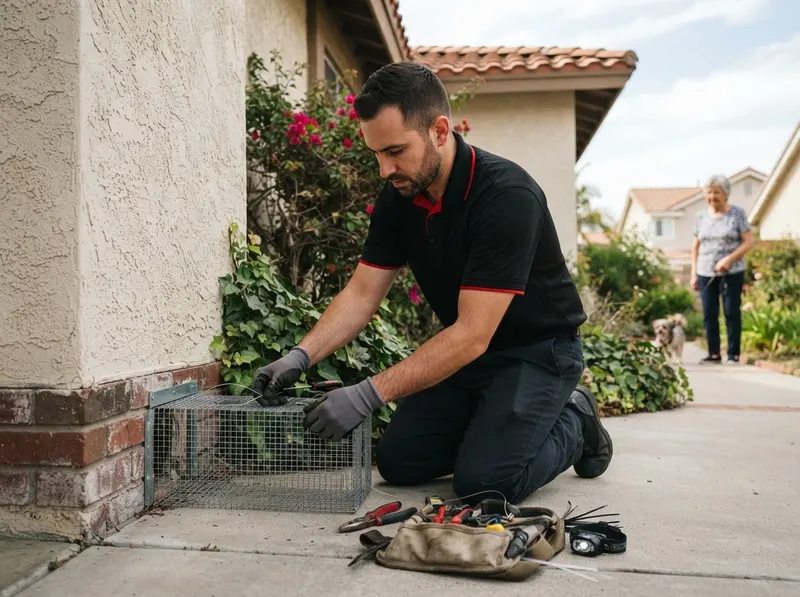
Nuisance wildlife intrusions create serious health risks when nocturnal animals bypass exterior defenses to den inside attics, soffits, and subfloor foundations. In high-density residential tracts like Ponderosa Park, West Anaheim, and Hermosa Village, Virginia opossums and striped skunks frequently nest beneath elevated porches, concrete patio slabs, and perimeter storage sheds. Further east toward the wildland-urban interface of Anaheim Hills, Canyon City, and properties near Oak Canyon Nature Center, raccoons and eastern fox squirrels consistently target wood-shake eaves, dormer roof intersections, and fascia gaps. Left unaddressed, these animals shred fiberglass batt insulation for nesting material, sever HVAC flex ducting, chew electrical wire insulation, and accumulate concentrated feces and urine that trigger respiratory concerns.
Effective animal management relies on accurate decision guidance based on structural location. If an animal is established beneath low ground decks or crawlspace vents, rigid steel mesh trenching paired with live cage trapping provides permanent eviction. If an animal accesses elevated attic voids along Spanish clay tile roofs in The Colony Historic District or multi-story townhomes near Platinum Triangle, technicians install spring-loaded one-way exit doors directly over primary entry holes. One-way funnels permit the wildlife to leave voluntarily to forage at dusk while mechanically barring reentry. When dealing with nursing mothers during spring breeding cycles between March and July, physical hand retrieval of juvenile kits is required prior to sealing points of entry, ensuring maternal instincts do not cause adult animals to destroy exterior siding attempting to break back inside.
Property owners must evaluate structural repair trade-offs during removal projects. Trapping alone captures the immediate animal occupying the space, but an unsealed eave invites neighborhood wildlife into the identical pheromone-marked void within days. Structural exclusion utilizes 1/4-inch or 1/2-inch 19-gauge hot-dipped galvanized hardware cloth screwed directly over gable louvers, foundation air vents, and plumbing stack roof flashings. While comprehensive exclusion and biohazard remediation add labor beyond standard trap deployment, physical mechanical barriers permanently terminate the invasion cycle without recurring service fees or hazardous chemical baits inside the home.
1. A technician conducts a thorough ground-to-ridge inspection to identify primary wildlife transit tracks, rub marks, droppings, and entry voids. 2. Humane cage traps or specialized one-way exclusion valves are strategically positioned along verified animal travel routes. 3. Traps are monitored daily according to California Department of Fish and Wildlife regulations until target animals are successfully cleared. 4. Entry access gaps are sealed using heavy-gauge metal flashing and chew-proof hardware mesh. 5. Affected attic spaces receive localized sanitation and enzyme deodorization to neutralize pheromone scent lines.
Every job gets a firm, written price after a free on-site visit.
Tell us about your wildlife removal job in Anaheim and we'll send a clear, written quote, usually the same day.
 Golden Grove Pest Control